
MARKET OVERVIEW
Despite ongoing geopolitical tensions, inflation concerns, and elevated interest rates, commercial real estate fundamentals remained resilient during the third quarter. Based on a conservative analysis of CoStar data, commercial real estate (CRE) transaction volume across the four major asset classes is projected to reach at least $96 billion, reflecting positive momentum from last quarter and a double-digit annual growth rate.
Industrial posted the highest transaction volume as confidence in the sector continued to improve. Distress activity remained low despite a July increase in CMBS delinquencies1, suggesting that while some property owners are facing challenges, broad-based financial stress has yet to materialize across the market. Overall loan performance swung positive in Q2, according to the Mortgage Bankers Association (MBA), thanks to the “continued stability of the commercial mortgage market.” Cap rates, after a period of little movement as tracked by CoStar, improved for the Office and Industrial sectors this quarter.
According to a recent survey2, most CRE professionals are committed to keeping the market moving. “Nearly $1 trillion of CRE maturities are forcing decisions, creating opportunities for those with capital, expertise, and the ability to execute. We'd all welcome lower rates, but they aren't required to invest,” commented one 25-year industry veteran. Investors remained disciplined even though the Federal Reserve provided fewer signals about future rate moves, and benchmark Treasury yields3 hovered near their highest levels in 18 months.
Rising material costs continued to limit new construction activity, helping support fundamentals across multiple property sectors. Multifamily concessions4 fell and the spring leasing season5 was robust, indicating that demand remains healthy in many markets. However, some areas continue to work through excess inventory created during the recent construction boom.
Ongoing geopolitical uncertainty kept some Industrial tenants cautious, contributing to relatively flat rent growth and vacancy6 rates. Many businesses remain hesitant to make large, long-term commitments until economic and trade conditions become clearer. At the same time, demand for certain industrial properties remained strong. Retailers expanded inventory stockpiles, e-commerce sales7 exceeded pandemic-era levels, and military manufacturing remained strong.
A recent CoStar sector report noted that Retail rebounded as value-oriented retailers helped backfill vacant space. This adaptability has enabled many shopping centers to maintain healthy occupancy levels despite shifts in consumer spending behavior.
With return-to-office and hybrid work arrangements becoming more established, the Office sector’s recovery continued to gain traction. Greater certainty around workplace strategies is helping companies make longer-term leasing decisions. CoStar reported that new leasing volume in the first half of the year hit the pre-pandemic average. Law firms and tech companies leased space early, anticipating limited inventory growth.
While New York state and a growing list of others have passed moratoriums on large new data centers, the data center sector remains one of commercial real estate's most dynamic segments. Inventory8 surged 80% year-over-year and absorption accelerated significantly as demand for AI, cloud computing, and data storage infrastructure expands. Texas, Virginia, Georgia, North Carolina, Arizona, and Pennsylvania lead data center growth, with secondary markets attracting increased investment nationwide. As construction accelerates, developers will need to navigate increasingly complex infrastructure and energy requirements.
A DEEPER DIVE – OFFICE CONSTRUCTION IN MAJOR MARKETS
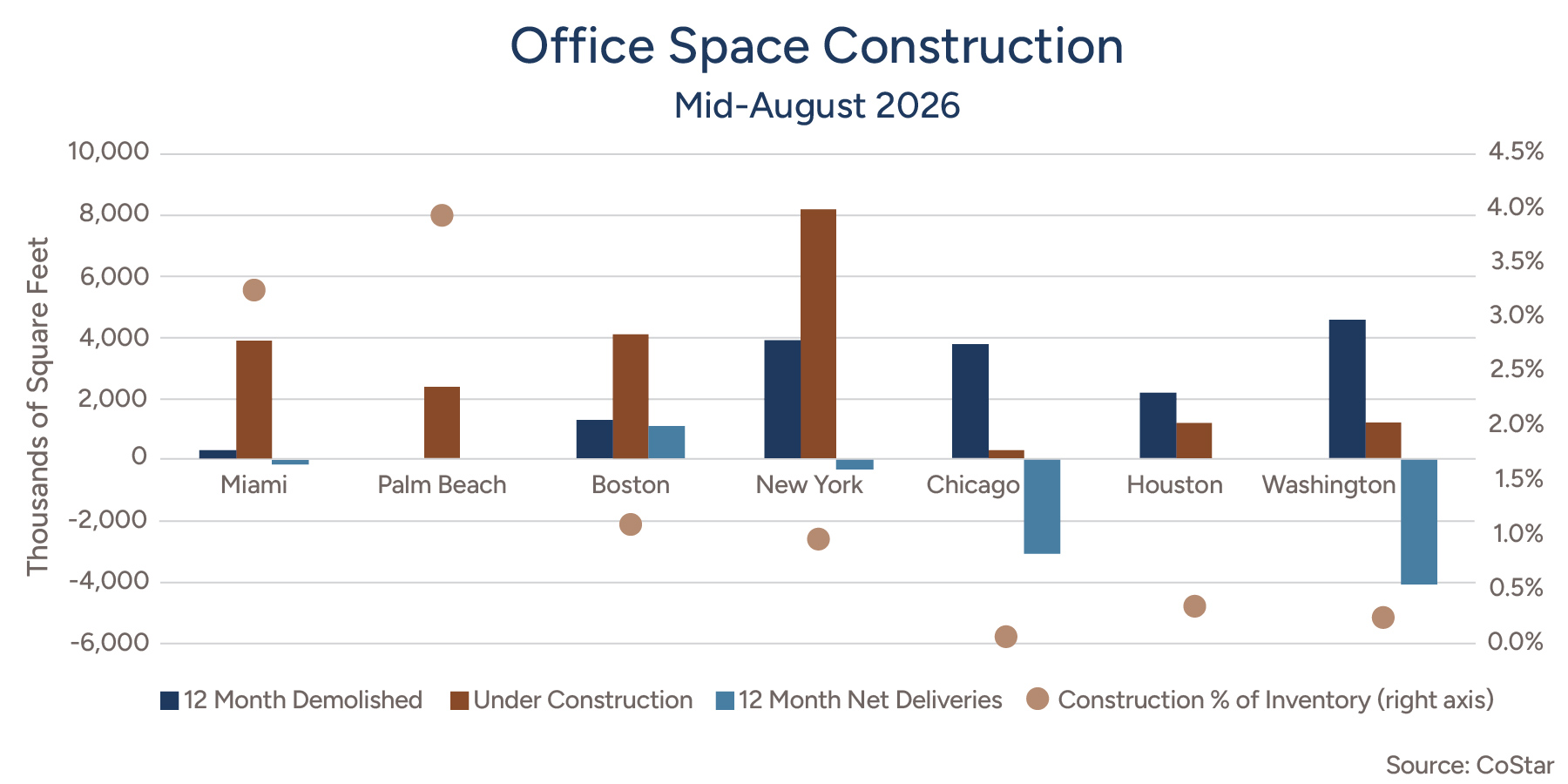
One reason for the Office sector’s recovery is the limited amount of new space entering the market. New office deliveries are approaching record lows, while over 9 million square feet of office space has been demolished each quarter for nearly three years, according to CoStar. At the same time, office-to-residential conversions continue to gain traction. Although these projects remain complex and costly, they are helping repurpose underutilized office properties. Combined with ongoing office removals, this trend is reducing available inventory and helping improve market fundamentals.
Comparing the nation’s largest office markets with those seeing the highest levels of new construction helps identify where recovery may accelerate and where it may take longer.
Markets Gaining Momentum
Miami continues to build momentum. While it ranks only 24th nationally by office inventory, it ranks fourth for office space currently under construction. Much of its older inventory has already been removed, leaving little demolition activity over the last year. With construction exceeding 3% of existing inventory, Miami is positioned to add meaningful office space in the coming years. Palm Beach presents an even stronger example, with 4% of inventory under construction, primarily in West Palm Beach.
Michael Dolan, SVP at Old Republic National Title Insurance Company and South and Southeast Regional Manager, attributes much of this activity to ongoing business migration: “Miami and West Palm Beach have become home to many of the nation’s leading business owners and investors, bringing companies, jobs, and the demand for office space with them to Florida."
Boston has turned the corner to positive net deliveries, with most projects occurring outside the Central Business District (CBD). New York ranks first nationally for both office inventory and space under construction. Its reinvention is well underway, with substantial building activity in Manhattan and Brooklyn helping offset the retirement of older, less competitive properties.
Markets Still Repositioning
Some markets may take longer to recover. Houston continues to remove older office buildings from its CBD while preparing sites for redevelopment and conversion. Construction remains measured but steady in suburban growth corridors. Chicago, the nation’s third-largest office market by inventory, has little new construction in the pipeline and remains focused on reducing obsolete space. In Washington, D.C., building activity has increasingly shifted to surrounding submarkets, while demolitions are centered in the K Street corridor.
WHAT’S NEXT?
As the industry heads into the final quarter of the year, key questions remain around interest rates, office recovery, and data center expansion. See how these trends unfold in Old Republic Title's next Economic Update.
Sources
1. CRED iQ, “CRED iQ CMBS Distress Report.” Reprinted with permission September 2026. https://cred-iq.com/blog/2026/07/31/cmbs-distress-hits-a-2026-high/
2. Bisnow, “62 Real Estate Insiders On A Year That Took A Turn, And What They're Doing About It.” Reprinted with permission September 2026. https://www.bisnow.com/news/national/capital-markets/62-real-estate-insiders-on-a-year-that-took-a-turn-and-what-theyre-doing-about-it-135235
3. Board of Governors of the Federal Reserve System (US), Market Yield on U.S. Treasury Securities at 10-Year Constant Maturity, Quoted on an Investment Basis [DGS10], retrieved from FRED, Federal Reserve Bank of St. Louis; https://fred.stlouisfed.org/series/DGS10, September 2, 2026.
4. Bisnow, “Rent Concessions Dip as Fewer Apartments Come Online.” Reprinted with permission September 2026.
https://www.bisnow.com/news/national/multifamily/rent-concessions-dips-as-fewer-apartments-come-online
5. Realpage.com, “U.S. Apartment Market Sees the Return of Annual Rent Growth.” Reprinted with permission September 2026. https://www.realpage.com/analytics/july-2026-us-data-update/
6. Copyright ©2026 “September 2026 Commercial Real Estate Market Insights Report.” NATIONAL ASSOCIATION OF REALTORS®. All rights reserved. Reprinted with permission September 2026. https://www.nar.realtor/sites/default/files/2026-08/2026-09-Commercial-Real-Estate-Market-Insights-Report-08-24-2026.pdf
7. Avison Young, “U.S. industrial market report H1 2026.” Reprinted with permission September 2026. https://www.avisonyoung.us/documents/d/us/h1-2026-us-industrial-market-report
8. Avison Young, “Q2 2026 U.S. data center market overview.” Reprinted with permission September 2026. https://www.avisonyoung.us/us-data-center-market-overview